Here’s what actually happens to most first-time parents: you receive a mountain of newborn-size gifts, your baby outgrows them in four weeks — some with the tags still on — and then you discover you own almost nothing in size 3-6 months, right when you’re too sleep-deprived to shop.
This article gives you actual numbers. How long babies really spend in each size, how many items you need per size range, and a planner to build your personal checklist based on your due date and the brands you’re planning to buy.
How long do babies actually wear each size?
This is the number nobody tells you, and it’s the reason most newborn wardrobes go wrong. Based on average growth curves, here’s roughly how long each size range lasts:
| Size range | Height | Typical duration |
|---|---|---|
| Newborn | 50–56 cm | 3–6 weeks |
| 0–3 months | 56–62 cm | 6–10 weeks |
| 3–6 months | 62–68 cm | 8–12 weeks |
| 6–9 months | 68–74 cm | 10–14 weeks |
| 9–12 months | 74–80 cm | 12–16 weeks |
Two things jump out of this table. First, the newborn size window is startlingly short. Three to six weeks — and that’s for an average baby. Babies born on the larger side (over roughly 4 kg or 55 cm) may skip newborn size entirely and go straight into 0-3M. Buying ten newborn sleepsuits is, statistically, a plan to donate seven of them unworn.
Second, the windows get longer as sizes go up. Your baby will spend three times longer in 9-12M than in newborn. Yet most wardrobes are stocked in exactly the opposite proportion — heavy on the smallest sizes, thin everywhere else. The pattern we see over and over: parents overbuy newborn and underbuy 3-6 months. Partly because tiny clothes are irresistible, and partly because of gifts — which we’ll get to below.
Lean, Regular or Generous — three ways to build a wardrobe
How many items you need per size depends mostly on one thing: how often you’re willing to run the washing machine. A newborn goes through 1–3 outfit changes a day (feeding spills, nappy leaks, the occasional full-scale laundry event). Here are three sensible approaches:
| Per size range | Lean | Regular | Generous |
|---|---|---|---|
| Bodysuits | 5 | 7 | 10 |
| Pants / leggings | 2 | 4 | 6 |
| Sleepsuits | 2 | 3 | 5 |
| Total across all 5 sizes | ~45 | ~70 | ~105 |
Lean (~45 items) assumes you wash every two days and don’t mind occasionally digging into the “next size up” box early. Regular (~70 items) is the comfortable middle: washing every 2–3 days with enough buffer that a rough night doesn’t empty the drawer — the right starting point for most families. Generous (~105 items) suits relaxed washing schedules, hand-me-down planning for a future sibling, or simply wanting slack in the system.
Seeing the totals is usually the surprise. “How many onesies do I need” quietly becomes “you will own somewhere between 45 and 105 pieces of clothing in year one.” Knowing that in advance is the difference between a wardrobe you planned and a pile you manage.
Build your personal plan
Every baby grows differently, and — here’s the catch — every brand sizes differently too. An H&M 62 does not cover the same height range as a Carter’s 0-3M, even though they’re aimed at the same age.
The planner below builds your checklist from your due date, your preferred wardrobe style, and the actual measurements of the brands you plan to buy — so the coverage is calculated in centimetres, not guesswork.
Newborn Wardrobe Planner
Build your personal checklist — then tick off what you already have.
Add what you already have — gifts, hand-me-downs, early purchases — and the planner shows exactly what’s still missing, sorted by what your baby will need first.
What about swaddles, socks and hats?
Deliberately not in the planner, because they don’t follow the same size progression — most are effectively one-size for the early months. Rough numbers to have on hand:
- Swaddles: 3–5 (you’ll use them constantly for the first three months, then almost never)
- Socks: 6–8 pairs (buy one brand, one colour — you will lose half of them)
- Hats: 2–3 (one for the hospital, one spare, one for outdoors)
- Sleeping bag / outdoor overall: 1–2 depending on your climate and season of birth
The gift overlap problem
Here’s a pattern every parent recognises after the fact: everyone buys newborn size, and nobody buys 6-9 months. Gifts cluster in the smallest sizes because tiny clothes are what people love to give. The result is a newborn drawer overflowing with clothes your baby will wear for a month at most — and a gap opening up exactly where the wardrobe windows get longer and the need gets bigger.
If you’re making a registry or wish list, request specific sizes. “We’d love clothes in 3-6M and 6-9M” is a perfectly normal thing to write, and the givers genuinely appreciate the guidance.
If the gifts have already arrived, add them to the planner above before buying anything yourself. You may find your newborn and 0-3M ranges are already fully covered — and that your actual shopping list starts at 62 cm.
One more thing: sizes lie
A quick word on why this planner works in centimetres rather than size labels. “0-3 months” is not a standard. Carter’s 0-3M tops out around 61 cm. H&M’s equivalent (size 62) runs to 62 cm. Some European brands cut generously, some American brands run slim — and the same label can cover a meaningfully different height range depending on whose tag it’s on.
That’s why counting “seven 0-3M bodysuits” can still leave you with a coverage gap: if they’re all from a slim-running brand, your baby may grow out of the whole batch weeks earlier than the label suggested. The planner maps every item to its real measured range, so seven bodysuits means seven bodysuits that actually cover the centimetres your baby will grow through.
If you want to go deeper on how specific brands size, we’ve measured and verified the charts for over 40 brands — including H&M, Carter’s, Next and Zara.
Frequently asked questions
How many newborn clothes do I need for the first month?
For the newborn size specifically: 5–7 bodysuits, 2–4 pants, and 2–3 sleepsuits covers a typical washing rhythm. Resist buying more — the newborn window averages just 3–6 weeks, and larger babies may skip it entirely.
Should I buy newborn size or 0-3 months?
Buy a small amount of newborn (it's genuinely too big to skip for most babies at birth) but put the bulk of your budget into 0-3M and 3-6M, where your baby will spend far more time. If your growth scans suggest a large baby, lean even harder toward 0-3M.
How many onesies does a newborn need?
5–7 per size range for a typical washing schedule of every 2–3 days. Newborns go through 1–3 changes a day, so fewer than five gets tight quickly.
How long do babies wear 0-3 month clothes?
On average 6–10 weeks — roughly from weeks 4–6 until the 3-4 month mark. It varies with your baby's birth size and growth rate, which is why planning by height in centimetres beats planning by age label.
Can I skip newborn size entirely?
If your baby is born over roughly 4 kg or 55 cm, quite possibly yes. Many parents keep just 2–3 newborn sleepsuits as insurance and start the real wardrobe at 0-3M.
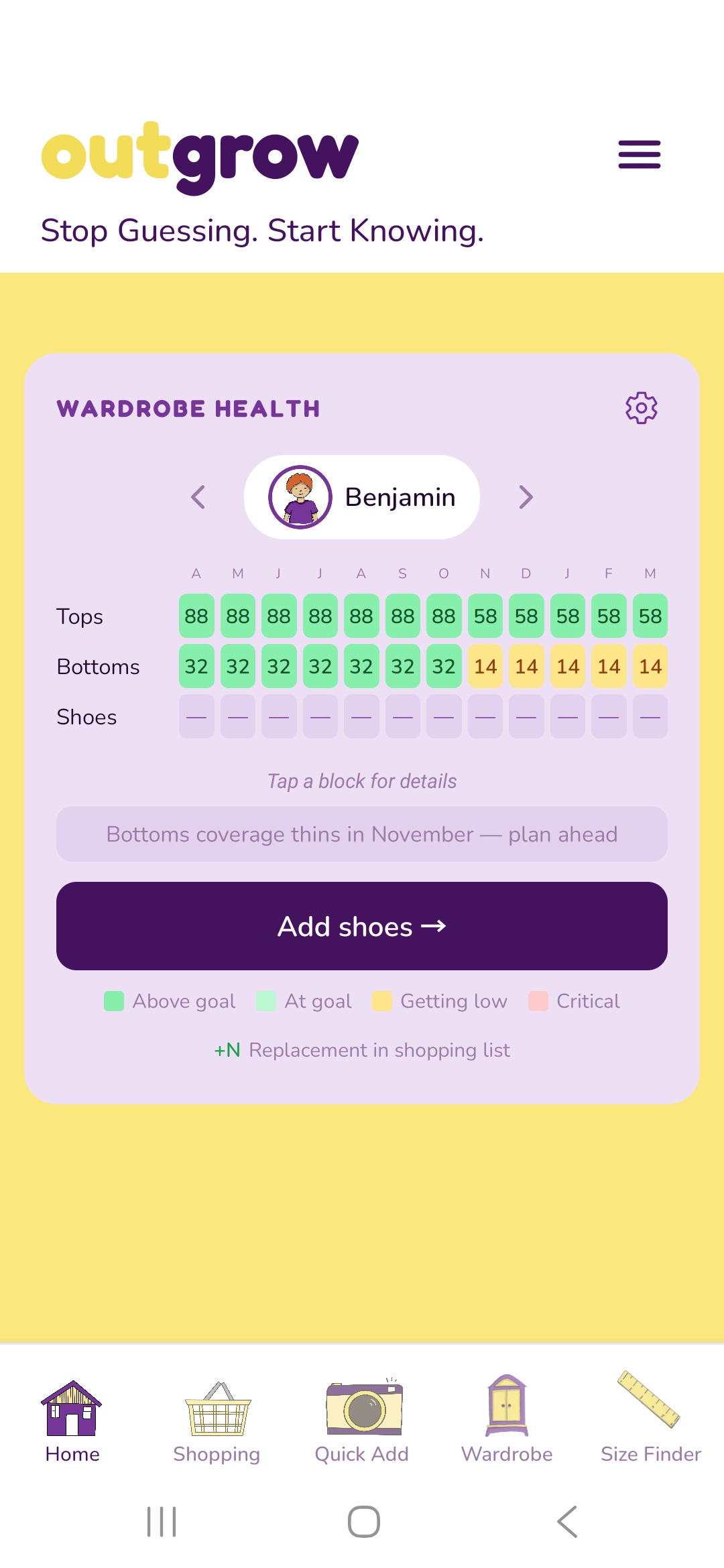
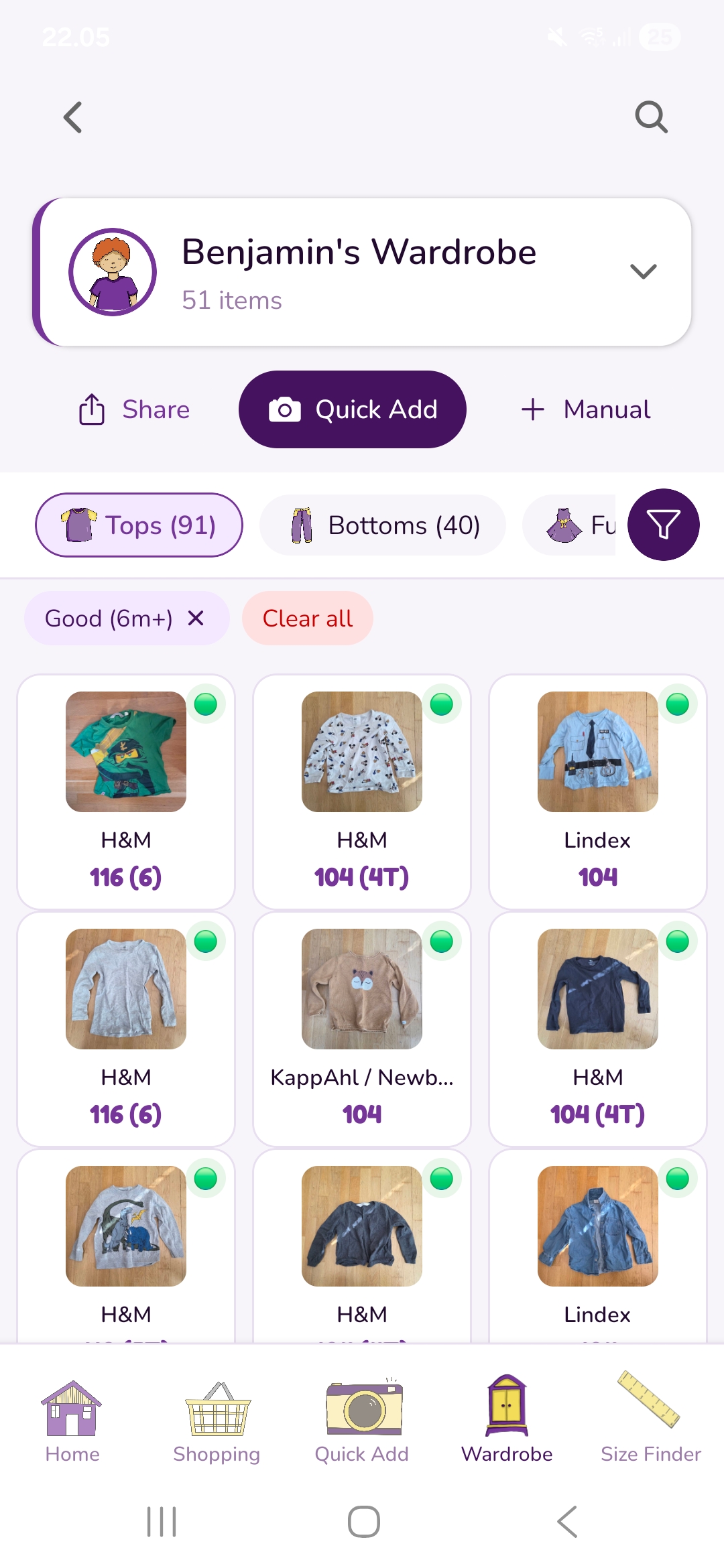
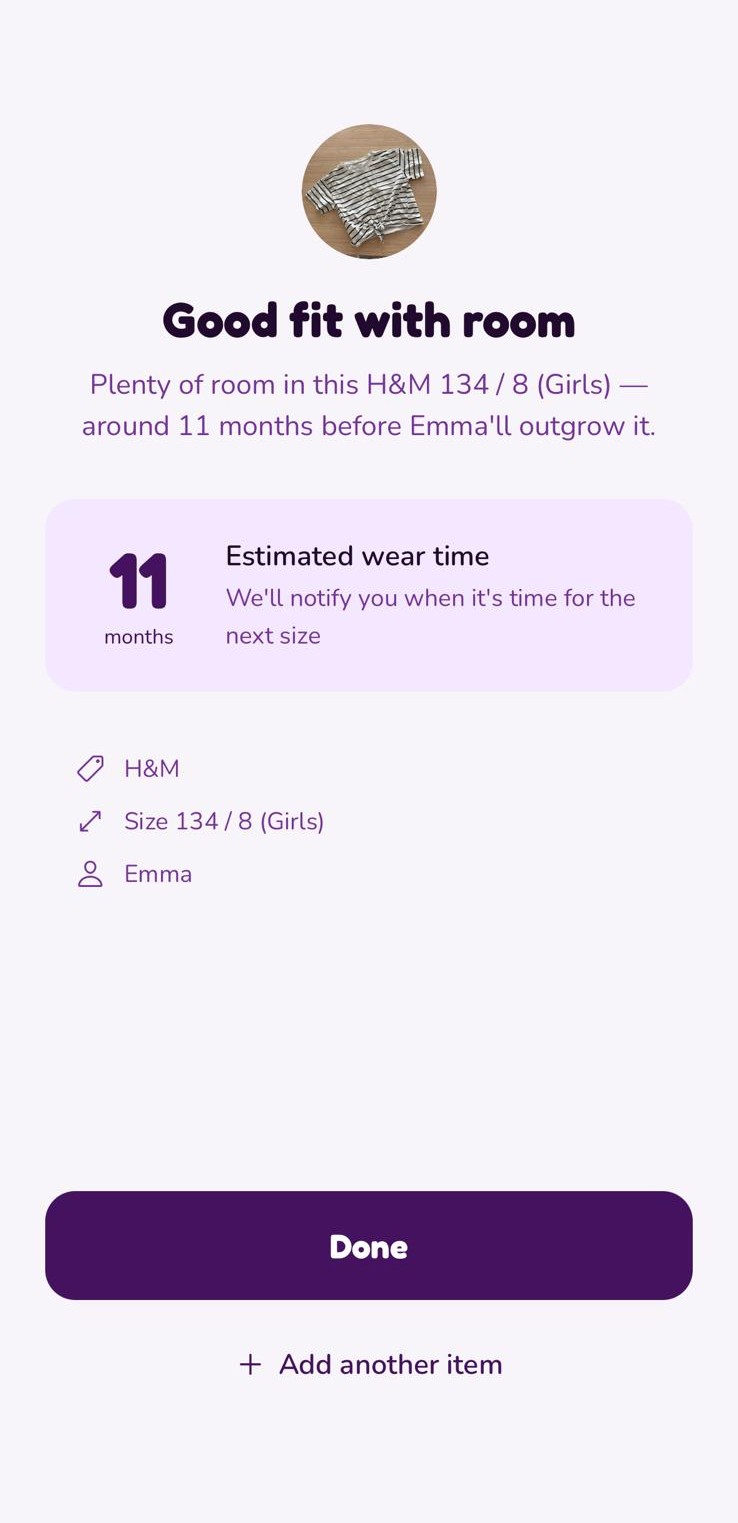
Expecting a baby? Outgrow’s Expecting flow lets you build this plan properly — track every gift as it arrives, see your coverage fill up across each size range, and convert to full wardrobe tracking the day your baby is born. Free on iOS and Android.